

Reality Is More Negotiable Than You Think
Most of us adopt our understanding of reality before we're old enough to question it.
We encode beliefs about success, about work, about leadership, about relationships, and about what's possible. Over time, those beliefs become so familiar that they stop feeling like beliefs at all. They begin to feel like reality itself.
I've spent much of my life exploring a different possibility. What if many of the limits we accept aren't fixed features of reality? What if they're features of our perception?
The Map Is Not the Territory
Every person carries an internal map of the world.
That map is shaped by experience, culture, education, success, failure, relationships, and countless moments that often go unnoticed.
The map helps us navigate. And… Every map leaves something out. When we mistake the map for reality itself, possibility shrinks. The questions we ask become smaller. The risks we take become safer. The future begins to resemble the past.
Transformation often begins with a simple realization:
The map can change.
Reality Emerges Through Relationships
I've become increasingly interested in the spaces between things, people, and ideas. I’m curious about the spaces between intention and action, between structure and emergence.
Organizations don't fail because people lack intelligence. They struggle because relationships lose coherence. Individuals don't usually become stuck because they lack potential. They become trapped inside stories that no longer serve them.
The invisible relationships often determine the visible outcomes.
That's why I spend less time asking, "What's wrong?" And more time asking things like, "What patterns are creating this?" And, “How did this manifest in my field?”
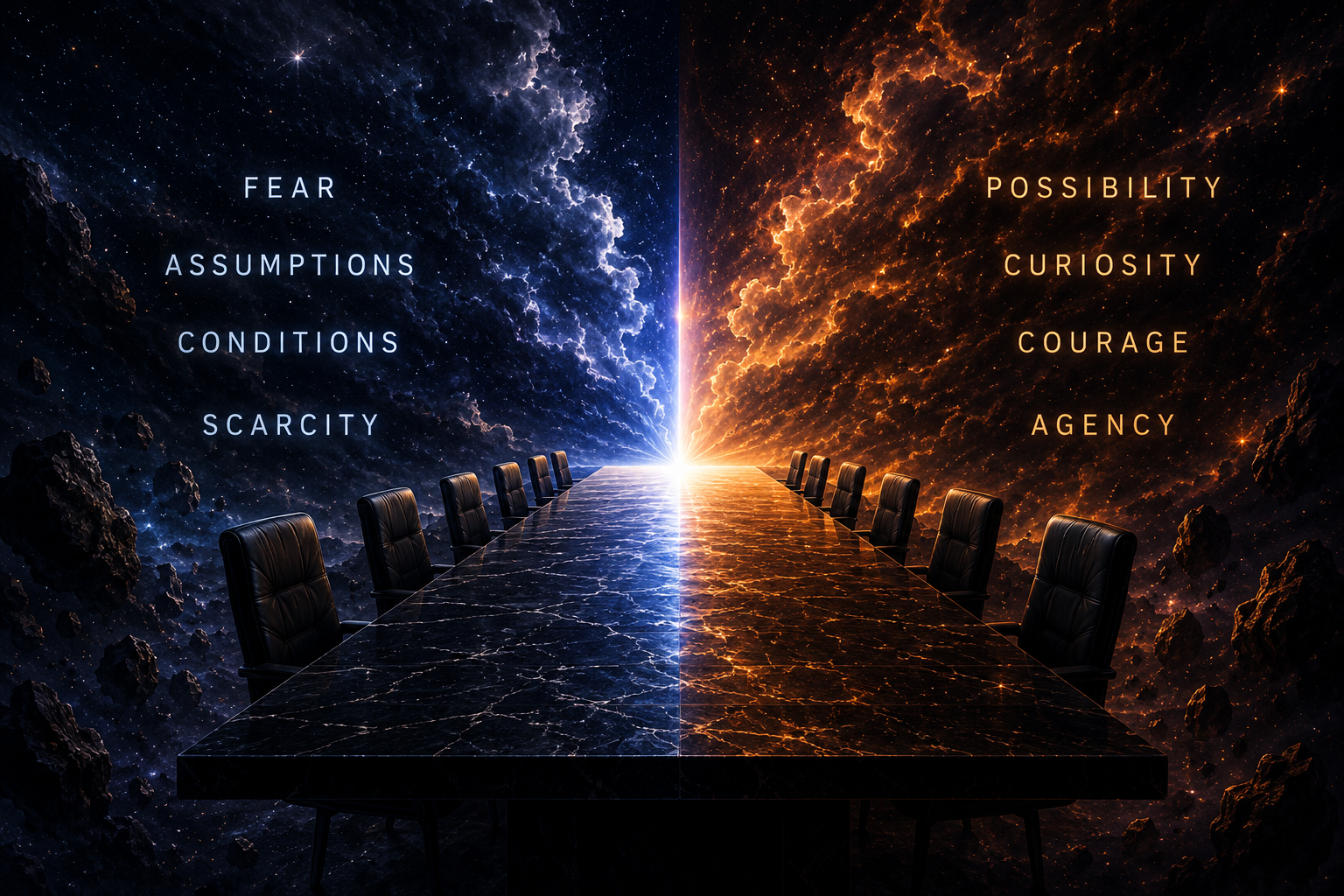
Curiosity Is a Strategic Advantage
Every person carries an internal map of the world.
The world rewards expertise. And expertise has a shadow. It can convince us we've already seen enough.
Curiosity keeps reality open. It allows us to notice weak signals, unexpected connections, and possibilities hiding in plain sight.
Some of the most important breakthroughs in my life have come from asking questions that initially sounded unreasonable.
Not because I expected easy answers.
Because good questions change the person asking them.

Coherence Creates Leverage
One idea keeps showing up in every domain I've explored.
When people become internally coherent, when their beliefs, values, attention, actions, and relationships begin moving in the same direction, they often accomplish far more with less effort. The same is true for organizations.
Most business coaches and consultants put a strong emphasis on efficiency and productivity. And those are great for linear gains in the existing Universe. But when you are looking to bend reality, coherence creates leverage.
Alignment isn't about agreement. It's about reducing unnecessary friction.
Coherence doesn't eliminate complexity. It allows complexity to become creative instead of chaotic.
Structure creates coherence. Coherence creates momentum. Momentum creates emergence.
Impossible is a negotiation
People sometimes ask me what I mean by that.
I don't mean that reality bends to wishful thinking, sitting in meditation “manifesting,” or that every dream is guaranteed. I mean something simpler.
Many of the things we call impossible are actually unexamined assumptions. History is full of individuals and organizations that succeeded because they questioned limits others accepted without inspection.
The impossible is often less a wall than an invitation. An invitation to think differently.
To experiment.
To learn.
To become someone capable of creating outcomes that once seemed out of reach.

This work
These ideas don't live only in books or conversations.
They're explored in practice. Sometimes with founders building companies. Sometimes with executive teams navigating change. Sometimes with individuals pursuing deeply personal Moonshots.
Different contexts, same questions.
How do people grow?
How do organizations evolve?
How do new possibilities emerge?
An Ongoing Exploration
I don't think of this philosophy as a finished system.
It's a living inquiry.
Every conversation teaches me something. Every organization reveals a new pattern. Every person expands my understanding of what humans are capable of becoming.
I'm less interested in defending certainty than in exploring possibility.
If these ideas resonate with you, I hope you'll keep exploring. The most interesting questions rarely have simple answers. And they often lead to extraordinary places.

What assumption about reality have you accepted without ever examining it?
The exploration begins there.